

Discharge Upgrades
Contact Us

Your DD Form 214:
The Most Important Document You May Ever Receive
When leaving the military, members receive a Department of Defense Form 214 (or an NGB-22, if National Guard). This is a summary of service, including discharge characterization. It can be a benefit in obtaining future education and employment. However, a DD-214 with adverse information can impair a veteran’s ability to secure meaningful professional opportunities.
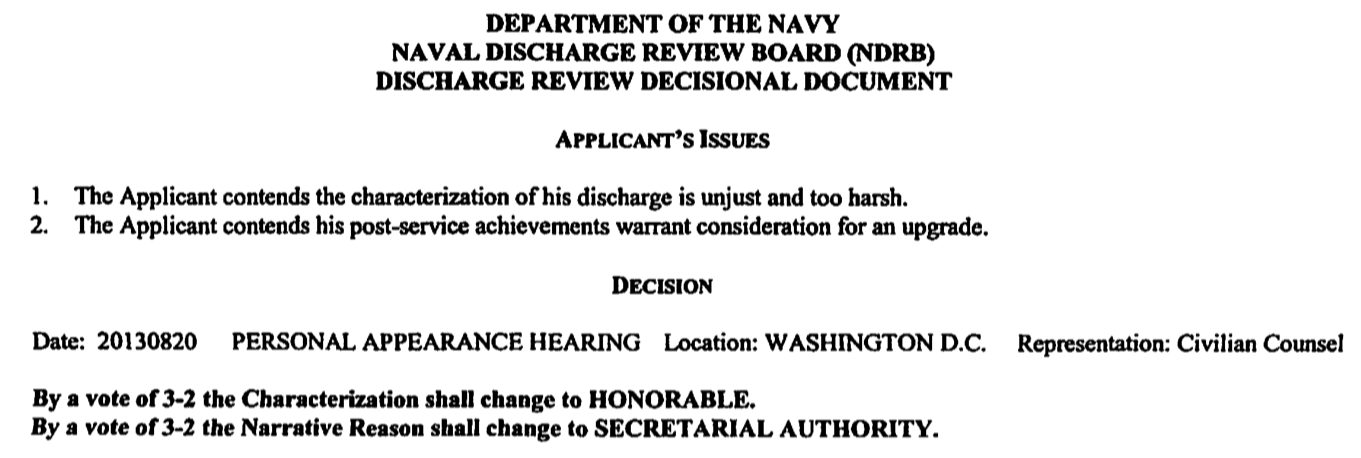
Each branch of service has a Discharge Review Board (DRB) that evaluates requests from former servicemembers who desire to have their discharge upgraded. Normally, this applies to those who receive a General, Under Honorable Conditions, Other than Honorable, or Bad-Conduct Discharge. Those who receive a Dishonorable Discharge or Dismissal are not eligible to apply to the DRB.
These less-than-honorable discharges can haunt you for life, socially and professionally. They may prevent meaningful employment or acceptance to colleges. In short, they stigmatize you. In many cases, the retention of a lawyer who understands the discharge upgrade process can make a difference.
Contact the Mayer GroupTypes of Discharges
Consider how various discharges might be regarded by potential employers and institutions of higher learning, especially given the availability of information on the internet:
Honorable
No problem. An Honorable Discharge labels an individual as someone who served with distinction. They receive all rights and benefits afforded to veterans. Of course, there’s no need to hire a discharge upgrade lawyer to help with one of these.
General, Under Honorable Conditions
Some potential problems. This individual may be viewed as having problems with discipline and conduct. Given a choice, most employers avoid hiring individuals with a General Discharge. Some benefits are lost–with the GI Bill being the most significant one. This characterization is eligible for consideration at the Discharge Review Board, and you may want to hire a discharge upgrade lawyer to help improve your chances.
Other Than Honorable
Significant potential problems. This individuals is viewed as having serious problems with discipline and conduct. Almost all employers avoid hiring these individuals due to their military record. A significant number of meaningful benefits are lost as a result of this. This characterization is eligibile for consideration at the Discharge Review Board, and you may want to hire a discharge upgrade lawyer to improve your chances of success.
Bad-Conduct, Dishonorable, or Dismissals
These are “Punitive Discharges” and are extremely stigmatizing. The abiltity to find meaninful employment and future success are hurt by both the discharge and the court-martial convictions. A bad-conduct discharge from a Special Court-Martial may be changed by the Discharge Review Board. Discharges imposed by a General Court-Martial are not eligible for review by the Discharge Review Board. These are tricky and usually require a more detailed analysis and informed military justice insight, such as you might receive from a discharge upgrade lawyer.
Uncharacterized/ Entry-Level Separation
These are normally imposed during initial entry training for individuals with less than 6 months of service. While not considered to be adverse in nature, they can still stigmatize a former servicemember as someone who lacked the motivation or ability to complete basic training. Upgrading or changing these can be difficult, and assistance from a military lawyer can increase your odds of obtaining a better service record.
The process to upgrade a military discharge is governed by service regulations, and it can be complicated and tedious. This is why seeking help in upgrading a subpar discharge normally requires professional assistance from someone familiar with the process–a military lawyer familiar with discharge upgrades. A large part of our practice revolves around assisting former service members as they attempt to improve the status of their military discharge.
On average, more than 10 hours are spent to prepare the necessary paperwork for each case. Occasionally, it is also necessary to travel to the DRB for a hearing. In military discharge upgrade cases, the burden is on you to prove that you deserve more. To improve your chances, hiring an experienced military discharge upgrade lawyer can make a difference.
Contact the Mayer GroupFifteen Years…
Currently, we are only accepting military discharge upgrade cases where the discharge occurred within the last 15 years, and this is because of procedural considerations that must be followed by discharge upgrade lawyers. Laws and regulations that govern discharge review boards are strict. An understanding of procedure is critical. In particular, the 15 year rule is never waived. If a date of discharge is beyond 15 years, a discharge review board (DRB) will not hear your case. For these older discharges, the case must go before a service’s Board for Correction of Military Records (BCMR), which has a much lower probability of success than the DRB. Even the best experienced discharge upgrade lawyers have difficulty at the BCMR.
For these reasons, we are only accepting discharges that are younger than 15 years old, unless you meet the criteria for our one exception to this rule.
The Exception
One exception exists to our general rule to not accept discharge upgrade cases older than 15 years. To be eligible for representation by our office with a discharge older than 15 years, an applicant must meet all the following criteria:
- Combat veteran or sexual assault victim (must have documented proof of combat service)(sexual assault victims must have suffered trauma while in the line of duty)
- PTSD Diagnosis as a result of combat service or sexual assault trauma (must be an actual diagnosis from a Psychologist or Psychiatrist (preferably more than one)). If prior-existing PTSD exists (such as childhood trauma), we must have documentation showing that this trauma caused or contributed to the misconduct that led to discharge.
- Must have been granted disability compensation by the VA for PTSD or denied compensation because of characterization of service.
- Must not have already appealed their case to the BCMR or DRB.
The Myth
Since the 1970s, a myth about discharge upgrades persists through military circles. That is the myth that General Discharges and Other-Than-Honorable Discharges are automatically upgraded after 6 months or 1 year. This is untrue. It began in the 1970’s when discharge review boards were created and tasked with reviewing discharge appeals for separations that occurred within the preceeding 15 years. When information about these boards reached military installations, many servicemembers interpreted it to be an automatic process. It is not.
Convincing these boards that you deserve an upgrade from a less-than-honoarble discharge is tough, and the burden of proof is on the applicant. Often, the 5 senior officers and noncommissioned officers sitting on the board demand overwhelming evidence before upgrading a discharge. They are a tough jury. So, in short, it is absolutely not an automatic process, nor an easy one. Having a military lawyer and discharge upgrade attorney in your corner to argue for a better characterization of service is no guarantee, but your chances are improved dramatically.
Recent Trends in Discharge Upgrades
Recently, we have seen a disturbing number of administrative separations resulting in General Discharges or Other than Honorable Discharges. Routine misconduct/allegations that once garnered a slap-on-the-wrist and a second chance are now resulting in terminated employment, lifelong stigma, and a loss of VA benefits. For this reason, we pay special attention to trends with the discharge upgrade boards.
Most disturbing is the trend of less-than-honorable discharges forced upon members of our Armed Forces suffering from Post-Traumatic Stress Disorder (PTSD) and Traumatic Brain Injury (TBI). Recent reductions in personnel have also meant a rise in adverse discharges–even for veterans with 10-20 years of service. Imagine dedicating 17 years of your life to a career and thinking that a retirement and benefits were undoubtedly in your future, then having that taken away, leaving your family without a reliable source of income and medical care. An adverse discharge is felt by a whole family, not just the targeted service member.
We will occasionally post updates on discharge upgrade trends here.
Win the Discharge you Deserve
If you received a less-than-honorable discharge, you owe it to yourself to fight for the honorable discharge you deserve. Even if you only served for a few years, you showed that you were willing to sacrifice yourself for freedom, and that deserves recognition, not stigma. Unless you feel confident presenting your case to the board, it helps to have an experienced military lawyer to present your case to the five senior officers who will decide your appeal.
Feel free to peruse some of our thoughts about discharge upgrades at Our Office Blog.
Further reading (Links are provided as a convenience. We cannot guarantee that the information at these sites is up-to-date.):
Yale Law School Discharge Upgrade Information
Do you need a Discharge Upgrade Lawyer near you?
How long does an upgrade take?
Resources (Links are provided as a convenience. We cannot guarantee that the information at these sites is up-to-date.):
Air Force Discharge Review Board
If you are a veteran or servicemember in need of representation for your discharge upgrade case:
Contact the Mayer GroupThe Mayer Group is licensed to provide representation in all areas of Military Law, up to and including trial representation. Each attorney is properly licensed to practice law within their respective states. As such, they are also authorized to represent clients before all military trial courts (courts-martial), military boards, appropriate federal agencies and boards, and federal proceedings before the EEOC and MSPB. Content of this site is for informational purposes only and is not legal advice.